
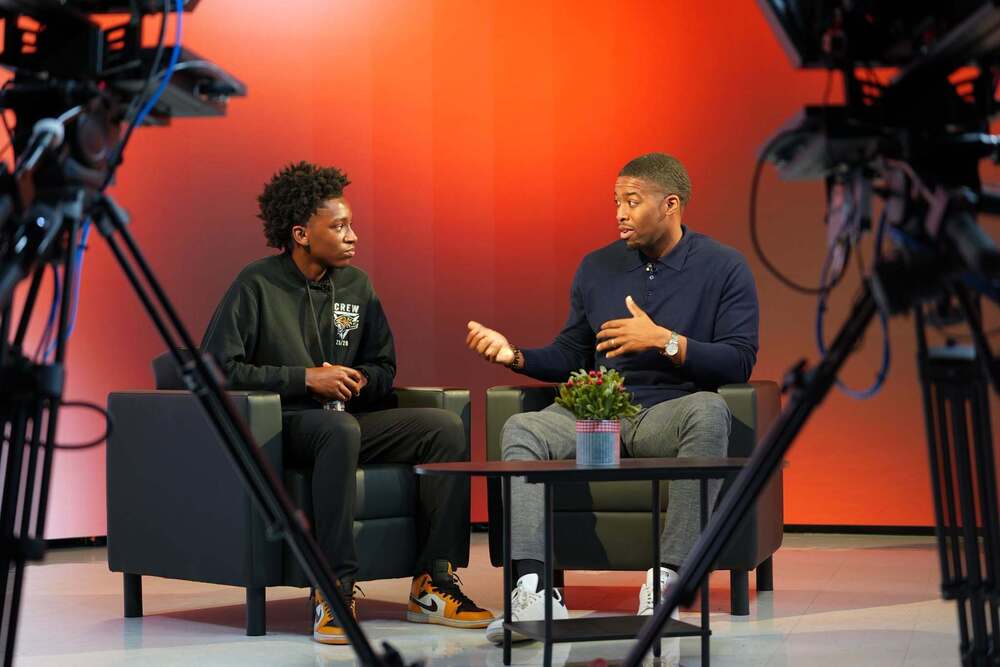
A student-led broadcast brings a professional perspective into focus — and lessons that reach beyond the studio
LINDEN HIGH SCHOOL, NJ (Nov. 13) — Jeffrey Wilkins had a question. Not about the cameras, the deadlines or what it takes to land a job at NBC News.
Which story had stayed with Marquise Francis?
The correspondent’s answer carried viewers of Linden High School’s Tiger News network far beyond the studio, to a Georgia community confronting its racial history — and a scholarship effort helping another generation move forward.
For the students behind the broadcast, it was a glimpse of what reporting can do. Then came a closer look at what the work demands.
Francis visited Nov. 13, joining Tiger News for its live, student-led Friday morning production. Wilkins, a senior, anchored alongside Victoria Vito and Alexandra Vasquez. They opened the show and covered high school happenings before Wilkins interviewed Francis in a one-on-one segment.
Superintendent Atiya Y. Perkins and Principal Charles Koonce were also in the studio. After the broadcast, Perkins sat down with Francis for a separate interview. He later joined the student reporting and production crew for a small-group Q&A.
The visit connected classroom work with professional experience in support of the district’s Strategic Priority 2: Personalized Pathways for Student Success. It also gave practical meaning to the district’s theme, “Back to the Basics with a Future-Focused Vision.”
The students were not simply watching a professional at work. They were doing the work themselves.
Start before the opportunity arrives
Francis’ advice was direct: Do not wait. “The biggest advice that I can give folks who are interested in this is just to start now,” he told Wilkins. Keep the ambition to work at NBC News or ESPN, he said. But look at what is possible today. Write for the school newspaper. Create a blog. Produce videos. Save broadcast clips.
An opportunity may come later. The evidence of what a student can do starts now. “The fact that you’re here right now interviewing me, all of your classmates are here putting on this broadcast is truly amazing,” he said.
When Wilkins asked about his favorite reporting assignment, Francis recalled covering a scholarship initiative for descendants of Black families forced out of Forsyth County, Georgia, more than a century ago. He spoke with a descendant who received support for college through the effort.
The assignment linked a painful past with new possibilities. For Francis, whose family has Georgia roots, it was personal. “That felt, for me, like, I’m having impact,” he said. “This is why I’m here.”
Behind the broadcast
Later, in the production room, the questions became more specific.
How do you direct a guest? How closely do you follow a script? What do you say between one interview question and the next?
Francis had watched the students’ broadcasts. He praised their segments and the stage manager’s work, then offered adjustments: Give guests clear directions. Tell them where to look. Take charge of the conversation.
And speak up.
“This is a production,” he said. “And so don’t be shy about anything you have to do.”
One student described the struggle to acknowledge an answer without falling back on the same response: “That’s interesting.”
Francis urged students to listen for an opening, not just wait for their next question. A passing detail might deserve a follow-up. An unexpected answer might change the direction of the interview.
“I think most good interviewers will tell you the best thing you’re gonna get from an interview comes in the follow-up questions,” he said.
Sometimes, he added, there is no need to fill the silence. Move naturally to the next question.
When the script changes
Preparation matters. So does the ability to let go of the plan.
Francis explained that anchors review scripts and adjust the language to sound conversational. Yet a carefully prepared report can change moments before airtime when new information arrives.
In the field, the task may be different altogether: Tell viewers what is happening. Describe what you see. Explain what you have learned.
All while the clock runs.
A producer may tell a reporter to wrap up in seconds, leaving little time to bring a complicated explanation to a clear finish.
Not every challenge is so complicated. Sometimes, someone coughs.
When the discussion turned to a student’s cough during the broadcast, Francis offered reassurance. Professionals deal with interruptions, too: a fly that will not go away, a sudden noise, construction in the background.
The answer is not to stop being human because a camera is on. Acknowledge what needs acknowledging. Keep going.
“Whatever is happening around you is real,” he said. “And so bring the viewer into it.”
A foundation for what comes next
Not everyone in the room planned to pursue journalism. Some were still deciding.
Francis made room for that uncertainty. Researching, asking thoughtful questions and telling a clear story, he explained, are skills students can take into other fields.