Linden Teacher Named Runner-Up for State Science Teaching Award
Kara-Lynne Frees-Spoganetz recognized for inquiry-based lessons, student opportunity and leadership in elementary science education
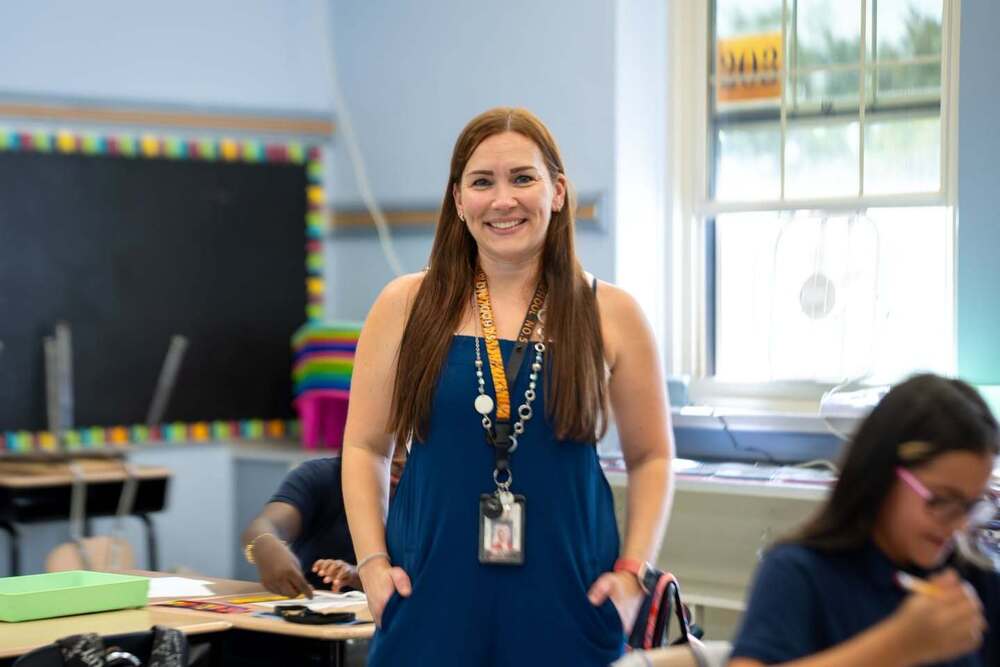
LINDEN PUBLIC SCHOOLS, NJ -- (Sept. 15) — Every day in Kara-Lynne Frees-Spoganetz’s School No. 5 classroom, students have an opportunity to ask questions, test ideas and discover their own potential as scientists.
That student-centered approach has earned Frees-Spoganetz statewide recognition. She has been named runner-up for the 2026 Anton Banko Award for Excellence in Teaching Elementary Science.
Frees-Spoganetz was one of five finalists for the statewide award, which recognizes outstanding kindergarten-through-sixth-grade science teachers in New Jersey. The award is presented by the New Jersey Science Convention in conjunction with the New Jersey Science Teachers Association.
The award honors Anton Banko, an engineer who co-invented small-incision cataract surgery. It recognizes teachers who use hands-on learning to encourage curiosity and inspire students to pursue science, technology, engineering and mathematics.
Recognition Reflects District Values
For Linden Public Schools, the recognition reflects the district’s commitment to impactful teaching and learning that empowers every student to reach their full potential through diversity and instructional excellence.
Superintendent Dr. Atiya Y. Perkins said Frees-Spoganetz’s work demonstrates the power of meaningful learning experiences and strong relationships among students, educators and the broader school community. “The time and care you invest in creating meaningful learning experiences for students is reflected in this recognition,” Dr. Perkins said.
Frees-Spoganetz has been an elementary educator for nearly 22 years. Her classroom reflects the district’s ROAR values: Resilience, Opportunities, Achievement and Relationships.
Students are encouraged to persevere when an experiment does not work, take ownership of their learning, celebrate progress and collaborate with classmates. In a safe and welcoming environment, every student is invited to contribute ideas, listen to others and see their own experiences and perspectives as valuable parts of the learning process.
Students Learn to Think Like Scientists
Frees-Spoganetz said her goal is to help students develop the habits of scientists by asking questions, testing ideas, gathering evidence and revising their thinking.
“Students are not taught to become isopod experts or memorize the structures and behaviors of a single organism,” Frees-Spoganetz observed. “Instead, they are taught to think like scientists.”
In one lesson, students investigate why isopods might be found beneath a flowerpot but not in nearby areas. They observe isopods, mealworms, fish and brine shrimp, record their findings and reconsider their initial explanations as they gather evidence.
The lesson gives students an opportunity to connect science to the world around them while building confidence in their ability to investigate complex questions. Their observations become a starting point for discussion, collaboration and deeper learning.
In another lesson, a video of a child lifting a wooden box while an adult cannot, prompts students to investigate electricity, magnets, forces and electromagnets.
Rather than receiving an immediate explanation, students develop theories, compare ideas and work together to determine what might be happening. The experience reinforces that questions are welcome, mistakes are part of learning and every student has a role in the investigation.
Engineering Challenges Build Resilience
Students also have designed magnetic figure skaters as part of an engineering challenge connected to a magnetism unit. They tested materials, evaluated their designs and made changes when their initial attempts failed.
The challenge builds resilience in action. Students learn that achievement is not always measured by a first attempt that works; it can also be found in the willingness to try again, seek feedback and improve.
“Her classroom is a place where every child is valued as a scientist, where curiosity is celebrated and where all students are empowered to actively participate in the work of science and engineering,” said Cynthia R. Apalinski, the district’s supervisor of science.
Leadership Extends Across the District
Those relationships extend beyond Frees-Spoganetz’s classroom. She supports science instruction throughout the district as a Tier 1 Science Teacher Leader, a member of the District Science Implementation Team and a lead teacher in the Science Lesson Study Collaborative.
In those roles, she helps teachers use curriculum resources and assessments, plan inquiry-based lessons, observe classroom instruction and reflect on teaching practices. Her collaboration with colleagues strengthens instructional excellence across Linden and expands opportunities for students in classrooms throughout the district.
Her work also reflects the importance of strong family and community partnerships. By connecting science to familiar experiences, encouraging students to share their thinking and helping them see themselves as capable problem-solvers, Frees-Spoganetz creates learning that can continue beyond the school day and into students’ homes and communities.
Continuing Professional Growth
As runner-up, Frees-Spoganetz will receive registration for the New Jersey Science Convention in October, two banquet tickets, overnight accommodations and $500 for classroom science supplies.
The award will provide another opportunity for professional growth and continued learning, but Frees-Spoganetz said her greatest goal remains helping students become confident, curious lifelong learners.
“My goal is to continue to foster my students’ natural curiosities, helping them to grow as lifelong learners,” Frees-Spoganetz said. “I hope when they leave my classroom, they leave with the confidence to continue asking questions and the excitement to seek answers.”