From Wind Turbines to Robots: Linden Students Put STEM Skills to Work
Two-week summer STEM Camp challenged middle school students to design, test and rethink solutions -- then took them inside Merck to see where those skills can lead
LINDEN PUBLIC SCHOOLS, NJ (Aug. 19) — For two weeks this summer, the Linden High School Academy building became a testing ground.
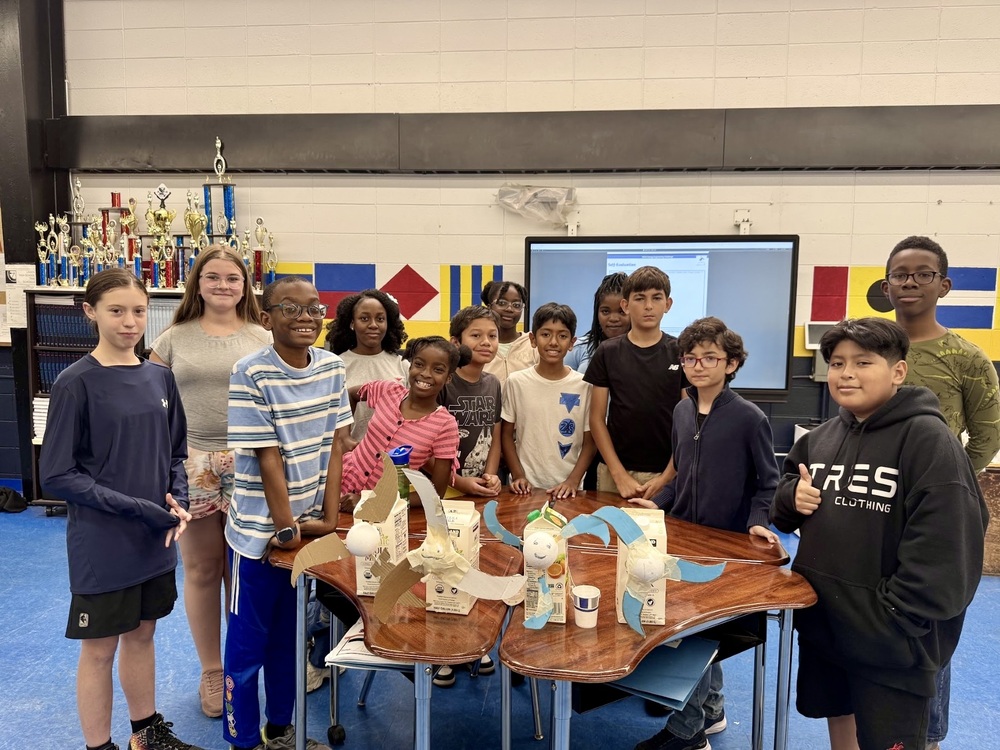
Middle school students built wind-powered devices, harnessed sunlight to cook, sent objects racing down ziplines and learned an essential lesson of engineering: The first design is rarely the final one.
Linden Public Schools’ STEM Camp, held July 13-16 and July 20-23, gave students an immersive summer experience connecting science concepts developed throughout their K-8 education with real-world engineering challenges.
“The STEM Camp provided middle school students with an immersive two-week experience designed to connect the science knowledge developed throughout their K-8 education with real-world engineering applications,” Cynthia Apalinski, the district’s supervisor of science, explained.
The camp culminated July 23 with a visit to Merck Global Headquarters in nearby Rahway, where the budding scientists built robots and spoke with professionals about careers in science, engineering and technology. But before that visit, there were problems to solve and prototypes to improve.
Building, Testing -- and Trying Again
During the first week, students took part in the “Catch the Wind: Turbine Design Challenge,” inspired by William Kamkwamba, who famously built a wind turbine using salvaged materials to help his family and community in Malawi.
Working in teams, campers applied their knowledge of forces, energy transfer, measurement and scientific reasoning to create wind-powered devices capable of lifting weights.
They designed, tested and refined their machines, using the results of each trial to determine what should change next. The process placed students in the role of engineers: Turn an idea into a design. Test it. Study what happened. Then improve it.
The second week brought a new energy source and a different challenge. For “Solar Chefs: The Sun-Powered Oven Challenge,” students used their understanding of heat transfer to design and improve ovens powered by sunlight. Campers developed hypotheses, collected data and examined the performance of their prototypes before making evidence-based adjustments.
A zipline challenge expanded their exploration of engineering design and materials science while reinforcing problem-solving, teamwork and persistence.
Learning From the Professionals
Throughout the camp, students strengthened more than their technical knowledge. Each activity required them to communicate, divide responsibilities, defend their decisions and listen to the ideas of others.
They also received guidance from professionals doing STEM work every day. After major challenges, student teams met by video conference with Merck engineers and scientists to present their designs and results, answer questions and receive feedback.
The mentoring sessions pushed students to explain not only what they built, but why they built it that way, supporting their choices with evidence and approaching setbacks as part of the engineering process. Students also explored careers in engineering, environmental science, renewable energy, biotechnology and biomedical research.
From the Classroom to Merck
The July 23 visit to Merck Global Headquarters brought those possibilities into sharper focus.
Students participated in robot-building activities and career roundtable discussions with Merck engineers, scientists and technology specialists. The experience gave campers a direct look at the people and skills behind STEM careers and showed how lessons learned in school can be applied to complex, real-world work.
The camp was a collaboration between the Linden Public Schools Science Department and Instructional Technology Department, led by Apalinski and Joseph Scaldino, supervisor of instructional technology and career and technical education.
Science Instructional Coach Kimberly Leight designed and supported the curriculum, while middle school science teachers Kimberly Terwilliger, Sana Abdelfattah and Dena Macchiarelli facilitated the program.
The experience was also supported through the district’s ongoing partnership with Merck, including the work of Moushmi Culver, Susan Beckert and Philip Yu.