
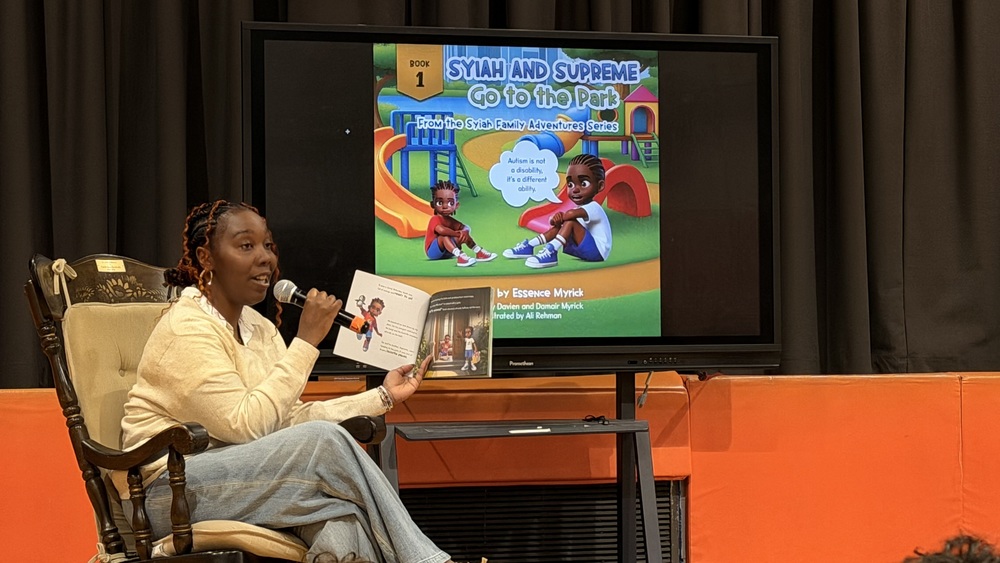
School No. 1 parent shares debut picture book with first and second graders
A parent author returns to School No. 1
Author Essence C. Myrick sat in a rocking chair at the front of the School No. 1 gymnasium, her colorful, illustrated book open wide as rows of first-grade students leaned forward on the floor, waiting for the next page to turn. Over the course of two back-to-back 40-minute sessions, she first read to all first-grade classes and then welcomed the second graders for the same interactive experience.
Myrick, a first-time author and School No. 1 parent, was one of the highlights of Autism Acceptance Month across the district in April, returning to the school her son attends to share her story about empathy and inclusion with young learners. The visit centered on her picture book, “Syiah and Supreme Go to the Park,” which uses a simple trip to the playground to explore how children treat peers who may communicate or interact differently.
Turning storytime into a lesson on kindness
Before the first story began, Principal Dave Walker stepped to the microphone to introduce Myrick and set the tone for the morning. “I’m so excited today because we have something very special here,” Walker told the students, asking them to “put your listening caps on” as he welcomed Myrick as both an author and a School No. 1 parent.
The gym, more often filled with bouncing balls and echoing voices, grew quiet as Myrick began to read. Rocking gently in her chair, she held up the book so students could see the bright, expressive illustrations of siblings Syiah and Supreme navigating their day at the park. On the gym floor, first the first graders, and later the second graders, sat cross-legged, eyes tracking every page and hands shooting up whenever she paused to ask what the characters should do next.
The book follows the brothers as they meet new children, decide who to invite into their games and notice when someone is left out. At one point, Myrick stopped at a scene where a child hesitates to include someone who seems different. “Being kind makes friendships grow,” she told the students, then asked what they would do if they saw a classmate trying to join a game but being ignored. Several students in each session volunteered answers: invite them to play, ask what they like to do, make sure no one is left standing alone.
Lasting impact beyond Autism Acceptance Month
Throughout both sessions, the reading shifted from simple storytime into an interactive lesson. Students acted out moments from the book, waved to mimic the characters, practiced taking turns and used thumbs-up or thumbs-down signals to show whether the behavior in the story reflected kindness or exclusion. Walker said seeing students respond so eagerly underscored why the school brings these kinds of experiences into the gym instead of keeping them confined to the classroom.
Teachers and staff watched as students drew connections between the fictional park and their daily routines, and some said they planned to refer back to the story in upcoming lessons on social-emotional learning, friendship and respect. By the time Myrick closed the book at the end of each session, the gym broke into applause as students lined up for photos, some clutching bookmarks and others eager to share their favorite part.
“Inclusion isn’t just something we talk about once during Autism Acceptance Month,” Myrick told a group of students as they posed for a picture. “It’s something you practice every day, with the way you treat each other.” For School No. 1, that daily practice now has two new guides in the storytime lineup: Syiah and Supreme, and the choices they make on a simple day at the park.
𝙒𝙧𝙞𝙩𝙩𝙚𝙣 𝙗𝙮 𝙈𝙞𝙘𝙝𝙖𝙚𝙡 𝘼. 𝙒𝙖𝙩𝙩𝙠𝙞𝙨
_________________________
𝙁𝙤𝙧 𝙈𝙤𝙧𝙚 𝙄𝙣𝙛𝙤𝙧𝙢𝙖𝙩𝙞𝙤𝙣, 𝙘𝙤𝙣𝙩𝙖𝙘𝙩:
𝙈𝙞𝙘𝙝𝙖𝙚𝙡 𝘼. 𝙒𝙖𝙩𝙩𝙠𝙞𝙨
𝙋𝙪𝙗𝙡𝙞𝙘 𝙄𝙣𝙛𝙤𝙧𝙢𝙖𝙩𝙞𝙤𝙣 𝙊𝙛𝙛𝙞𝙘𝙚𝙧, 𝙇𝙞𝙣𝙙𝙚𝙣 𝙋𝙪𝙗𝙡𝙞𝙘 𝙎𝙘𝙝𝙤𝙤𝙡𝙨
908-486-2800 𝙀𝙭𝙩. 80026 | ✉️ 𝙢𝙬𝙖𝙩𝙩𝙠𝙞𝙨@𝙡𝙞𝙣𝙙𝙚𝙣𝙥𝙨.𝙤𝙧𝙜